Foodle is a food-themed word puzzle that follows the familiar daily guessing format popularized by Wordle. The goal is simple: identify a hidden food-related word in a limited number of guesses by using color clues after each attempt. Still, the food vocabulary can make the game surprisingly tricky. A guess that seems like a normal five-letter word may not fit because the answer could be an ingredient, dish, fruit, spice, cooking term, or regional food name.
This guide explains how to play Foodle from your first guess to your final attempt. You will learn what the tile colors mean, how to choose stronger opening words, how to avoid wasting guesses, and what to do when you are left with several possible answers. It also covers common variations between Foodle-style websites, since not every version uses exactly the same word length or rules. By the end, you should be able to approach the daily puzzle with a clearer, more reliable strategy.
Foodle Basics
Foodle is generally a once-a-day word game centered on food vocabulary. Most versions ask you to guess a five-letter answer in six tries, although the exact format can vary by website. Each accepted guess must usually be a valid word, and some versions only accept food-related entries.
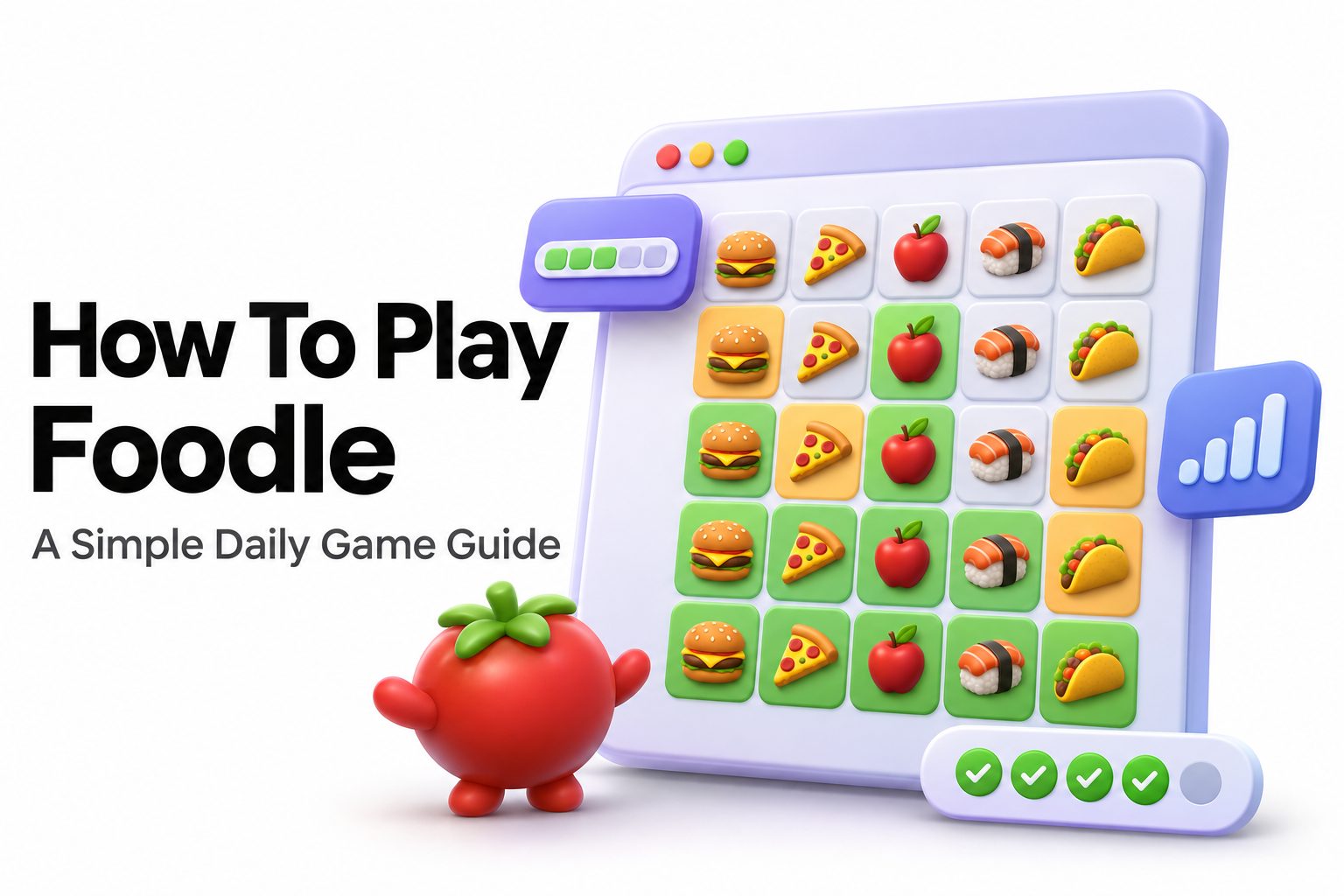
After you submit a guess, the game changes the color of each letter tile. Those colors show whether a letter appears in the answer and whether it is positioned correctly. You then use that feedback to narrow the possibilities with every new guess.
Reading the Color Clues
A green tile means the letter is in the correct position. Keep that letter where it is unless later information proves you made an incorrect assumption about a repeated letter.
A yellow tile means the answer contains that letter, but it belongs somewhere else. A gray tile means the letter is not in the answer in that position, and in most versions it does not appear in the answer at all. Repeated letters can create exceptions, so pay attention to the full pattern rather than treating every gray tile as an absolute rule.
Starting a New Foodle Puzzle
Open the Foodle game site and look for the empty row of tiles and on-screen keyboard. Type a valid first word, then press Enter or select the submit button. The puzzle will reveal color feedback immediately.
A strong first guess is usually broad rather than overly specific. It should test common vowels and useful consonants without repeating letters. You are collecting information first, not trying to guess the answer in one move.
A Practical First-Puzzle Checklist
- Confirm the answer length before you type.
- Check whether the site requires food-related guesses.
- Use a first word with several different letters.
- Watch for green, yellow, and gray clues after every guess.
- Keep a mental note of letters already ruled out.
- Avoid reusing a letter in the same position after it turns yellow.
Choosing Better Opening Guesses
Your opening guess can shape the entire puzzle. Food words often contain familiar vowels, but they also include less common letter combinations than general Wordle answers. An opening word that tests A, E, I, O, and common consonants can quickly reveal the structure of the target.
For example, a word such as “stare” tests two common vowels and three frequent consonants. It may not be food-related, so it will only work on versions that accept general dictionary words. If Foodle limits entries to food terms, choose an accepted food word with varied letters instead of forcing a standard Wordle opener.
Using Food-Themed Opening Words
Food-based starters can be helpful because they test letters likely to appear in food names. Words such as “toast,” “cream,” “spice,” “lemon,” and “sugar” may provide useful information, depending on the target length and the game’s dictionary.
The downside is that some food terms repeat common letters or overcommit you to one category. “Toast,” for instance, includes two vowels but repeats the letter T. That can be worthwhile if you are testing a likely word pattern, but a first guess with five distinct letters often gives broader feedback.
When General Words Make Sense
If the version you are playing accepts any valid dictionary word, do not feel obligated to guess only food names at first. General words can test letter frequency more efficiently, especially when the puzzle has not revealed a food category.
Once you have several confirmed letters, shift toward food vocabulary. A pattern such as _ A _ E _ could produce many ordinary words, but the Foodle theme helps you prioritize possibilities such as “dates” or “caper” when they fit the clues.
Solving the Puzzle Step by Step
The best Foodle strategy is a process of elimination. Treat each guess as evidence. A good second or third guess may not look like a likely answer, but it can be more valuable than a random attempt if it tests several unknown letters.
Use the tile colors to build a working pattern. Write it down if necessary, especially when the answer includes repeated letters or you have several plausible food terms in mind. This slows you down slightly but prevents avoidable mistakes.
1. Make an opening guess with varied letters.
2. Lock green letters into their confirmed positions.
3. Move yellow letters into new positions without repeating their failed placement.
4. Remove gray letters from your candidate list.
5. Use a second guess to test high-value unused vowels and consonants.
6. Start forming food-related candidate words once the pattern becomes clear.
7. Save your final attempts for words that fit every clue, not merely words that seem food-related.
Using the On-Screen Keyboard
Most Foodle games include a keyboard that changes color as you play. It is useful for quickly seeing which letters remain available, but it does not replace careful reasoning. A keyboard may show a letter as gray even when repeated-letter rules make the situation more complicated.
For instance, if you guess a word with two Es and only one E exists in the answer, one tile may be colored while the other turns gray. The colored tile confirms the letter’s presence, while the gray one tells you that you have used it too many times or placed it incorrectly.
Making Sense of Repeated Letters
Repeated letters are one of the most common reasons players lose an otherwise solvable Foodle puzzle. Food words can contain doubles, including terms such as “pizza,” “apple,” “cocoa,” and “onion.” When you see mixed colors for the same letter, assume the game is giving you quantity information as well as position information.
Do not rule out a letter completely just because one copy appears gray. Instead, compare every instance of that letter in your guess. A green or yellow copy means at least one instance belongs in the answer; the gray copy may indicate that only one occurrence is needed.
Food Vocabulary That Helps With Foodle
Foodle answers can come from more than restaurant menus. The daily word may be a whole dish, a vegetable, a seasoning, a grain, a beverage, a cooking method, or a food adjective. Building a broad mental list makes it easier to recognize possible answers from partial letter patterns.
Think in categories when you get stuck. If the puzzle contains “_ R _ _ E,” do not search only for meal names. Consider produce, baking items, condiments, proteins, and culinary verbs. This prevents you from overlooking a simple answer because you are focused on the wrong type of food.
Useful Food Categories to Consider
| Category | Examples of possible answer types |
| — | — |
| Fruits and vegetables | apple, berry, onion, mango |
| Ingredients | flour, yeast, cream, olive |
| Dishes and snacks | sushi, pizza, pasta, taco |
| Herbs and spices | basil, cumin, clove, thyme |
| Drinks and desserts | cocoa, latte, sorbet, mousse |
| Cooking terms | roast, blend, glaze, sear |
Some answers may be familiar in one region and less common in another. Keep an open mind about spellings, singular and plural forms, and names borrowed from other cuisines. The game’s dictionary decides what counts, not your personal food vocabulary.
You can also improve your range by reading food-focused word games and recipe content. An [Internal Link: food word games] can introduce related puzzle formats, while an [Internal Link: common cooking terms] can help you recognize culinary vocabulary that may appear in future puzzles.
Avoiding Common Foodle Mistakes
The biggest mistake is treating every guess as a shot in the dark. Foodle rewards players who use the clues methodically. Randomly trying food words can feel productive, but it often repeats letters that have already been ruled out and leaves too little information for the last attempts.
Another common error is assuming the answer must be a famous dish. The word could be something ordinary, such as a staple ingredient or a preparation term. When your guesses do not fit, broaden your category before assuming the puzzle is obscure or unfair.
Mistakes That Cost Valuable Guesses
- Reusing gray letters because a word “looks right.”
- Leaving a yellow letter in the same position.
- Ignoring the possibility of double letters.
- Guessing only popular dishes instead of ingredients and cooking terms.
- Using a word with several repeated letters too early.
- Forgetting that plural forms may be accepted in some versions.
- Submitting a guess before checking it against all known clues.
A Useful Second-Guess Strategy
Your second guess should respond to the first set of color clues. If your opening word reveals no useful letters, choose a new word with mostly unused vowels and consonants. This gives you a wider letter map before you begin narrowing the answer.
If the first guess reveals one or two yellow letters, build the next attempt around testing their positions while introducing new letters. Avoid placing a yellow letter back in the exact spot where it failed. The goal is to learn both where letters can go and which letters accompany them.
Example of a Logical Guess Sequence
Imagine that you guess “toast” and receive a yellow O, a green A in the third position, and gray tiles for T and S. You now know that O belongs in the word but not in the second position, A stays in the middle, and T and S should not be used again.
A thoughtful next guess might test O in a different location while adding fresh letters such as C, R, or M. You are not required to identify the final food word immediately. You are trying to create a pattern that makes the next choice obvious rather than merely hopeful.
When Several Answers Fit the Pattern
Late-game guess traps happen when the board leaves several words that differ by only one letter. You may see a pattern like _ A _ E _ and know the answer is food-related, yet still have multiple candidates. In this situation, a direct answer guess is not always your best move.
Use a “testing” word when possible. It should include several of the competing letters at once, even if it cannot be the answer. One information-rich guess can separate three or four candidates and protect your final attempt.
Choosing Between Candidate Words
| Situation | Better move |
| — | — |
| Only one food term fits every clue | Guess the answer |
| Two possible answers differ by one letter | Test the differing letters first |
| You have two guesses left | Use an information-rich word if several options remain |
| A candidate conflicts with a gray or yellow clue | Remove it immediately |
| The answer may contain a repeated letter | Recheck tile behavior before guessing |
This approach feels slower than instinctive guessing, but it improves your odds. Foodle is not only a vocabulary test; it is also a pattern and probability puzzle. The strongest players use each remaining turn to reduce uncertainty.
Handling Invalid Guesses
An invalid guess usually means the word is not included in that site’s accepted dictionary. It does not necessarily mean the word is misspelled or unrelated to food. Different Foodle versions use different word lists, and some are more restrictive than others.
When a valid food term is rejected, do not waste time trying to force it through. Choose another word that tests the same letters or use a more common spelling. If you play a particular Foodle site regularly, you will soon learn whether it accepts broad culinary vocabulary, proper names, plurals, or regional terms.
Differences Between Foodle Versions
“Foodle” can refer to more than one food-themed guessing game. The most common format uses a daily word and colored tiles, but websites may differ in answer length, reset time, accepted guesses, and whether the solution must be a food item.
Before applying a strategy, check the game board. A six-letter puzzle calls for different opening choices than a five-letter puzzle, and an unlimited-play version removes the pressure of a single daily attempt. The core logic remains the same: identify the answer through accurate use of feedback.
What to Check Before You Play
- Number of letters in the answer
- Number of allowed guesses
- Whether the puzzle resets daily
- Whether only food-related guesses are accepted
- Whether hard mode is available
- Whether previous answers or hints are offered
- The site’s local reset time
Hard Mode and Hint Features
Some Foodle-style games offer a hard mode that requires you to reuse confirmed letters in every new guess. This makes the puzzle more demanding because you cannot always play an exploratory word that ignores the current pattern.
Hints can be useful when you are learning, but use them carefully if you want the full challenge. A category clue may quickly reveal whether the answer is a fruit, dish, or ingredient, which changes the puzzle from open-ended deduction into a more focused vocabulary search.
Improving Your Foodle Skills Over Time
Regular play builds pattern recognition. You start noticing common food endings, likely vowel placements, and the kinds of terms a particular game favors. Keep track of difficult answers for a few weeks, especially words you knew only after seeing the result.
It also helps to review your losses without treating them as failures. Ask whether you missed a clue, guessed too quickly, or simply lacked the word in your vocabulary. A missed repeated letter calls for closer tile reading; an unfamiliar spice or dish calls for broader food knowledge.
Quick Ways to Improve
1. Use opening words with different letters.
2. Do not ignore small color details.
3. Build a mental list of short ingredients, herbs, and dishes.
4. Practice with food word puzzles beyond the daily game.
5. Pause before your fourth and fifth guesses to review every clue.
6. Use testing guesses when multiple answers remain.
7. Learn from the answer after each unsuccessful puzzle.
Playing With Friends and Sharing Results
Many daily Foodle versions let you share your completed result as a grid of colored squares. This shows how many attempts you used without revealing the answer, making it easy to compare performances with friends.
Be considerate when discussing the daily word. Sharing the solution directly can spoil the puzzle for people in other time zones or those who have not played yet. Use spoiler warnings in group chats, and share the grid rather than the answer when possible.
Conclusion
Foodle is easy to start but rewards deliberate thinking. Begin with a varied guess, read every tile carefully, and let the feedback guide your next move. Green letters stay in place, yellow letters need new positions, and gray letters usually belong outside your future guesses. The food theme adds a useful layer of context, but it should not make you limit your thinking to famous dishes alone.
The most dependable way to improve is to balance food knowledge with word-puzzle logic. Consider ingredients, drinks, spices, produce, desserts, and cooking terms when building candidate words. When several answers fit, use a strategic test word instead of hoping your next guess is lucky. Once you learn how to play Foodle with that methodical approach, the daily puzzle becomes less about random guesses and more about solving a satisfying culinary word challenge.
Frequently Asked Questions
How many guesses do you get in Foodle?
Most Foodle versions give you six guesses to find the hidden word. The exact number can vary by site, so check the board before starting. Each submitted guess should provide useful letter and position information.
Are all Foodle answers food words?
Usually, yes. Answers are commonly foods, ingredients, drinks, spices, dishes, or cooking terms. Still, each site uses its own word list, so the category may be broader or narrower than you expect.
Can you use regular words in Foodle?
It depends on the version. Some Foodle games accept regular dictionary words as guesses, while others require food-related entries. If a normal word is rejected, use an accepted culinary term that tests similar letters.
What do yellow tiles mean in Foodle?
A yellow tile means the letter appears somewhere in the answer but is in the wrong position. Use that letter again in a different spot, while avoiding the placement that the game has already ruled out.
Does Foodle have a new puzzle every day?
Many Foodle sites publish one daily puzzle that resets at a scheduled time. Some also offer archives, unlimited modes, or practice games. Check the version you use because reset times and play options differ.