Numberle looks simple at first glance: make a valid calculation and use color clues to find the hidden equation. The challenge is that you are not only guessing digits. You also need to think about operators, equals signs, and whether the completed expression actually works. That is why knowing how to play numberle matters more than rushing through random combinations.
Most Numberle games give you a fixed number of spaces and several attempts to uncover one correct mathematical equation. Each guess must fit the board and be mathematically valid. After every attempt, colored tiles show which characters are correct, misplaced, or absent. This article explains the rules, a dependable starting strategy, how to read the clues, and the mistakes that often waste turns. By the end, you will be able to approach daily puzzles with a clear method instead of treating each row like a lucky guess.
What Numberle Is
Numberle is a logic puzzle inspired by word-guessing games, except the answer is a mathematical equation rather than a word. A typical puzzle may contain eight characters, such as `12+34=46`. Your aim is to identify the exact sequence before you run out of guesses.
The format can vary slightly between websites and apps. Some versions use six attempts, while others allow more or less. Most include digits from 0 to 9, common operators such as plus, minus, multiplication, and division, and an equals sign.
The Basic Rules of Numberle
Every row you enter must be a valid equation. For example, `15+24=39` is valid because both sides have the same value. A string such as `15+24=38` may fit the available spaces, but it should be rejected because the calculation is false.
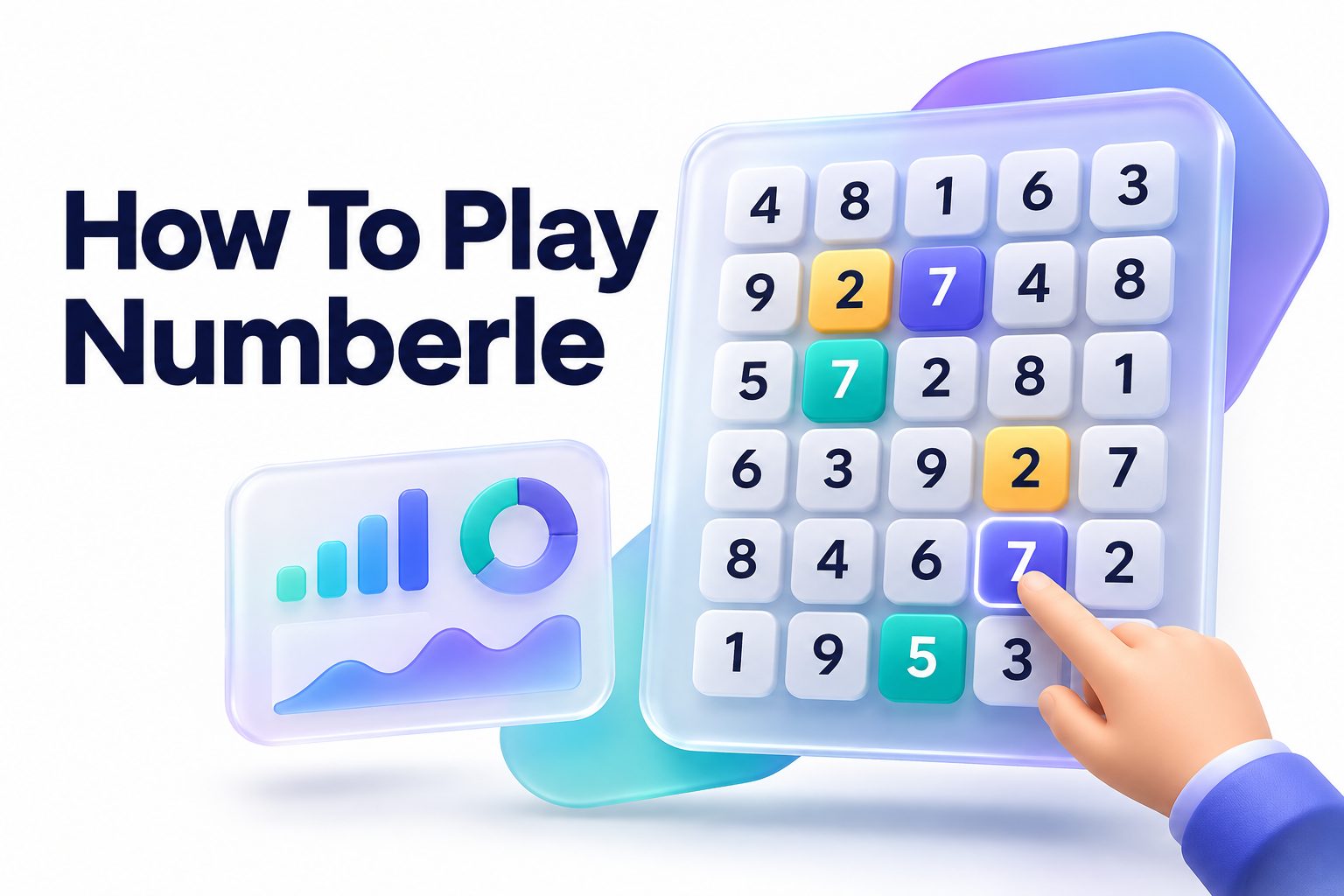
After submitting a valid guess, the game marks each character with a color. Green usually means the character is correct and already in the right position. Yellow or orange usually means the character appears in the answer but belongs somewhere else. Gray means it does not appear in the target equation, subject to duplicate-character rules.
How Tile Colors Guide Your Next Guess
Treat tile feedback as evidence, not a scorecard. A green digit locks down one position and narrows the possible equations. A yellow operator tells you that the operation may matter, but it needs to move. A gray character can usually be removed from future guesses.
Repeated digits require extra care. If you enter an equation containing two `2`s and only one tile changes color, the solution may contain just one `2`. The exact duplicate behavior depends on the version, so compare your feedback across several guesses before assuming both copies are present.
A useful way to interpret the board is:
- Green tiles confirm both the character and its position.
- Yellow or orange tiles confirm the character but rule out that position.
- Gray tiles usually eliminate that character from the solution.
- Multiple colored copies can reveal how many times a digit or symbol appears.
- The equals sign is normally fixed in a valid position pattern, making it a valuable structural clue.
Building a Valid Equation
Before guessing strategically, make sure you can quickly check whether an equation is valid. Read the expression using standard arithmetic order: multiplication and division are completed before addition and subtraction unless brackets are explicitly allowed by that version of the game.
For example, `2+3×4=14` is valid because `3×4` equals 12, then adding 2 gives 14. By contrast, `2+3×4=20` is not valid. Numberle puzzles often reward players who pause long enough to verify the calculation before hitting submit.
Some versions do not allow negative answers, decimal points, brackets, or equations that start with zero. Look at the available keyboard characters and any rule notes before planning around those possibilities. Restrictions differ, and a valid equation in one Numberle game may not be accepted in another.
Choosing a Strong First Guess
Your first guess should reveal as much information as possible while remaining mathematically correct. Many players prefer an equation with several different digits and at least one common operator, such as `12+34=46`. It tests six distinct digits, a plus sign, and the equals sign in one move.
There is no single perfect opener because the answer structure varies. A puzzle that uses subtraction may give little immediate value from a plus-based guess. Still, an opening equation with varied digits is generally more useful than one that repeats a digit several times without a reason.
Use these practical starting principles:
1. Include as many different digits as the equation length allows.
2. Use a simple, valid equation that is easy to verify.
3. Avoid repeated digits in the first row unless you are testing a specific pattern.
4. Try a common operator first, then switch operators if feedback suggests it.
5. Keep the answer length in mind so your guess matches the board exactly.
A Step-by-Step Method for Solving Numberle
Once your opening row has produced feedback, solve the puzzle in stages. The most reliable approach separates structure from calculation. First work out which characters can appear and where they can go, then build valid equations from those constraints.
Do not force one favorite formula onto the board. If the colors contradict it, abandon it quickly. Good Numberle players change direction when the clues require it, especially after an operator or equals sign is confirmed in an unexpected location.
Lock Down the Equation Structure
Start with any green characters. Mark their positions mentally or on paper, then note every position forbidden by yellow tiles. The equals sign is especially important because it divides the left-hand calculation from the result on the right.
Next, estimate the likely number of characters on each side. If the equals sign is in the sixth position of an eight-character puzzle, you may have five characters on the left and two on the right. That immediately limits possible calculations.
Test Digits Without Wasting Rows
Use your second or third guess to test new digits when the first row produced mostly gray tiles. Build another valid equation that avoids eliminated characters while introducing numbers you have not tried. This gives you more usable information than rearranging the same unknown digits blindly.
For instance, if `12+34=46` rules out 1, 2, 3, and 4, a later guess might test higher digits with a different valid structure. Always check that the result and total character count are correct before entering it.
Calculate Only After Narrowing Options
As the board fills with green and yellow tiles, list equations that fit the remaining pattern. Suppose you know the answer resembles `_5+2_=7_`. You can test candidate values that create a valid total while respecting the unused digits and required locations.
This is where arithmetic becomes a filter. Instead of guessing every possible digit placement, calculate what values could produce the visible answer. The stronger your structural clues, the fewer equations you need to consider.
Reading Operators and Equals Signs
Operators are often more informative than digits because each one changes the kind of equation you can form. A confirmed plus sign suggests additive relationships; a confirmed multiplication sign can produce larger results from short inputs. Do not assume the operator stays in the same position unless its tile is green.
The equals sign also deserves attention. It cannot appear just anywhere in a normal equation, and the answer side must contain a value that matches the left side. Once you know its position, you can estimate whether the solution likely uses one-digit or two-digit results.
Common Numberle layouts include:
| Equation pattern | Example | What it suggests |
|—|—|—|
| Two digits, operator, two digits, equals, two digits | `12+34=46` | A compact addition or subtraction equation |
| One digit, operator, two digits, equals, two digits | `7×12=84` | Multiplication may be possible |
| Two digits, operator, one digit, equals, two digits | `45-6=39` | A two-digit result is likely |
| Three digits, operator, one digit, equals, two digits | `108÷2=54` | Division or a larger starting value may fit |
Handling Repeated Digits and Symbols
Repeated characters create some of the trickiest Numberle feedback. A solution might include two zeros, two identical digits, or an operator that appears only once. Your guesses should reflect what the color clues actually prove, not what seems visually likely.
For example, if one `5` becomes green and another `5` becomes gray in the same row, the target may contain only one `5`. If both copies receive positive feedback, the answer probably contains at least two. This distinction can prevent an entire row from being built around an incorrect assumption.
Repeated digits are often useful later in the game, when the board pattern strongly suggests them. Early on, distinct digits typically give more information. Save deliberate duplicate testing for the point where you need to determine quantity rather than simply identify which characters are available.
Arithmetic Checks That Prevent Bad Guesses
A valid Numberle guess must satisfy the equation, so mental arithmetic is part of the puzzle. Check each side before submitting. For addition and subtraction, this is usually quick; multiplication and division deserve an extra moment because small errors are easy to miss.
Pay attention to order of operations. In a version that allows more than one operator, `8+6÷2=11` is valid, since division happens first. Reading it strictly from left to right would produce the wrong answer. If the game documentation does not make its rules clear, begin with single-operator equations until you know what it accepts.
Before submitting, run through this checklist:
- Does the equation use exactly the required number of characters?
- Is the equals sign included once and placed logically?
- Does each side of the equation have the same value?
- Have you followed the game’s rules for zeros, decimals, or negative values?
- Does the guess avoid characters already shown as absent?
- Does it place yellow characters somewhere new?
Common Mistakes That Cost Attempts
The most common mistake is treating Numberle like a digit-placement game and ignoring mathematical validity. A row cannot merely fit the green and yellow pattern; it must also make sense as an equation. That means arithmetic should guide every potential answer.
Another mistake is continuing to use gray digits because they help create convenient totals. Once a digit is confidently eliminated, find another equation. Reusing it gives up a chance to test new information and can lead you to misread the remaining possibilities.
Guessing the Result Before the Expression
It is tempting to focus on the digits after the equals sign because they look like a direct answer. Yet the result is only useful when it matches a valid left-hand expression. Work from both sides at once, especially when you know the operator.
A partial pattern such as `__+__=5_` may have many possible totals. The left side narrows those options far more effectively than guessing every number in the result position.
Forgetting Position Rules for Yellow Tiles
A yellow or orange tile means “present elsewhere,” not “close enough.” Putting that character back in the same slot wastes the clue. Write down forbidden positions if the game board is getting crowded or you are solving a difficult puzzle.
This matters most with operators and repeated digits. A misplaced plus sign can radically change the equation structure, while a misplaced repeated digit can make an otherwise valid total impossible.
When to Change Your Strategy
Change direction when two or three attempts have failed to add useful information. For example, if your plus-sign guesses keep producing a gray plus sign, try a valid subtraction, multiplication, or division equation that introduces fresh digits. The board is telling you that your initial structure may be wrong.
You should also shift from broad testing to targeted calculation once several characters are known. Early guesses are for information. Late guesses should be built around confirmed positions and a short list of mathematically possible equations. Mixing those goals at the wrong time causes unnecessary misses.
If you enjoy number-based daily puzzles, [Internal Link: daily math puzzle strategies] can help you develop the same pattern-recognition habits across related games. The core skill is not speed alone; it is learning when a clue is strong enough to narrow your choices.
Practical Numberle Example
Imagine an eight-character puzzle. Your first guess is `12+34=46`, and the feedback tells you that `+` and `=` are green, `4` is yellow, `6` is gray, while 1, 2, and 3 are gray. You now know the answer uses addition, has the same symbol positions, includes a 4 elsewhere, and excludes several low digits.
Your next guess should preserve the confirmed structure but test fresh numbers. You might choose a valid equation such as `45+78=123` only if the board has enough spaces; if it does not, create an eight-character alternative that meets the game’s limits. The important point is to test 4 in a new place and introduce unused digits.
As you gather more feedback, stop using numbers that have been eliminated. If the resulting pattern becomes `4_+_5=_9`, calculate possibilities rather than guessing. A short list of totals will quickly reveal which values fit the confirmed positions.
Useful habits for faster solving:
- Keep a small mental list of digits that are confirmed, misplaced, and excluded.
- Check the length of both sides before doing detailed arithmetic.
- Use a calculator only if the puzzle rules allow it and you want assistance with complex expressions.
- Prefer one clear test per guess over a row that repeats uncertain characters.
- Review [Internal Link: logic puzzle solving tips] if you want to improve clue tracking and elimination skills.
Platform Differences to Watch For
Numberle is played on several websites and mobile apps, so the exact rules are not always identical. Some games accept multiplication as `*`, while others use `×`. Division may appear as `/` or `÷`. A few versions include parentheses, exponent symbols, or decimal points, while others keep the keyboard deliberately simple.
Look for rule text before your first guess. It may explain whether equations can contain leading zeros, whether both sides can include operators, and how duplicate digits are marked. These details do not change the core strategy, but they can affect which candidate equations are accepted.
Many daily versions also use a single shared puzzle each day. Practice modes, archived puzzles, and unlimited games may have different difficulty settings. If a game rejects a mathematically correct equation, the issue is often its character-length or formatting rule rather than your calculation.
Conclusion
The best way to approach Numberle is to combine logical elimination with accurate arithmetic. Start with a valid equation that tests a range of digits, read every tile color carefully, and use the equals sign and operator positions to narrow the equation’s structure. As the board becomes clearer, replace broad exploratory guesses with calculations that fit the confirmed pattern.
Repeated digits, order of operations, and platform-specific rules can make a puzzle feel harder than expected, but they are manageable when you slow down and verify each row. Avoid reusing eliminated characters, move misplaced tiles to genuinely new positions, and do not submit an expression until both sides are equal. Once you use this method consistently, how to play numberle becomes less about lucky guesses and more about solving a compact logic problem one clue at a time.
Frequently Asked Questions
Numberle goal?
The goal is to find the hidden valid mathematical equation within the allowed number of guesses. You use colored feedback after each equation to identify the correct digits, operators, equals sign, and their exact positions.
Valid equation requirement?
Yes, every submitted row normally has to be mathematically correct. The equation must also match the board length and available symbols. A correct placement pattern will not help if the calculation itself is false.
Best first guess?
A strong first guess uses several different digits and a simple valid equation, such as one containing addition. This reveals more information than repeating digits early, while keeping the arithmetic easy to check.
Yellow tile meaning?
A yellow or orange tile usually means that character appears in the hidden equation but is in the wrong position. Move it to a different valid location in your next guess instead of repeating it unchanged.
Numberle versus Wordle?
Numberle uses the same clue-based guessing concept as Wordle, but the answer is a valid equation rather than a word. You must consider mathematical correctness, symbol placement, and order of operations alongside tile colors.