Cowordle turns the familiar five-letter word puzzle into a live multiplayer challenge. Instead of quietly working through a daily grid on your own, you play against another person, react to their progress, and try to reach the same hidden word first. That added pressure makes every guess matter: a word that is excellent for gathering information can also give your opponent a clue to exploit.
Learning how to play cowordle is simple because the basic tile system follows Wordle. The real difference lies in the match format, turn timing, and the way you use the information visible during a game. You still need to identify a five-letter answer within a limited number of guesses, but now speed, observation, and sensible word choices all affect the result.
This article explains the core rules, how to start a match with a friend or another player, what the colored tiles mean, and which strategies help without turning a quick word game into a stressful exercise. It also covers common mistakes, useful opening-word habits, and what to do when different Cowordle sites use slightly different rules.
What Cowordle Is and How It Differs From Wordle
Cowordle is a multiplayer Wordle-style game. In the most common version, two players receive the same secret five-letter word and race to solve it. Each player makes valid five-letter guesses, receives colored tile feedback, and tries to find the answer before the other player does.
The central puzzle mechanics are familiar, but the objective changes. Standard Wordle is mainly about solving efficiently in a set number of attempts. Cowordle adds competition: you must solve efficiently while staying aware that the other player may be one strong guess away from winning.
Some sites also describe their version as cooperative or turn-based. In those formats, players may alternate guesses or share information on a common puzzle. Before a match begins, take a moment to check whether you are racing independently, alternating turns, or working together.
What You Need Before Starting a Match
Most Cowordle games run in a web browser and do not require a download. You generally need a phone, tablet, or computer with an internet connection, although the layout is often easiest to read on a larger screen.
For a private game, one player normally creates a room and sends an invite link. The other player opens the link, joins the session, and waits for the game to begin. Random matchmaking is available on some versions, but private links are usually the better choice when you want to play with a specific friend.
Starting a Cowordle Game With a Friend
Creating a match is usually quick, but both players should join before the countdown or first turn begins. If one player is using a slow connection, it helps to refresh before creating another room rather than repeatedly sending new links.
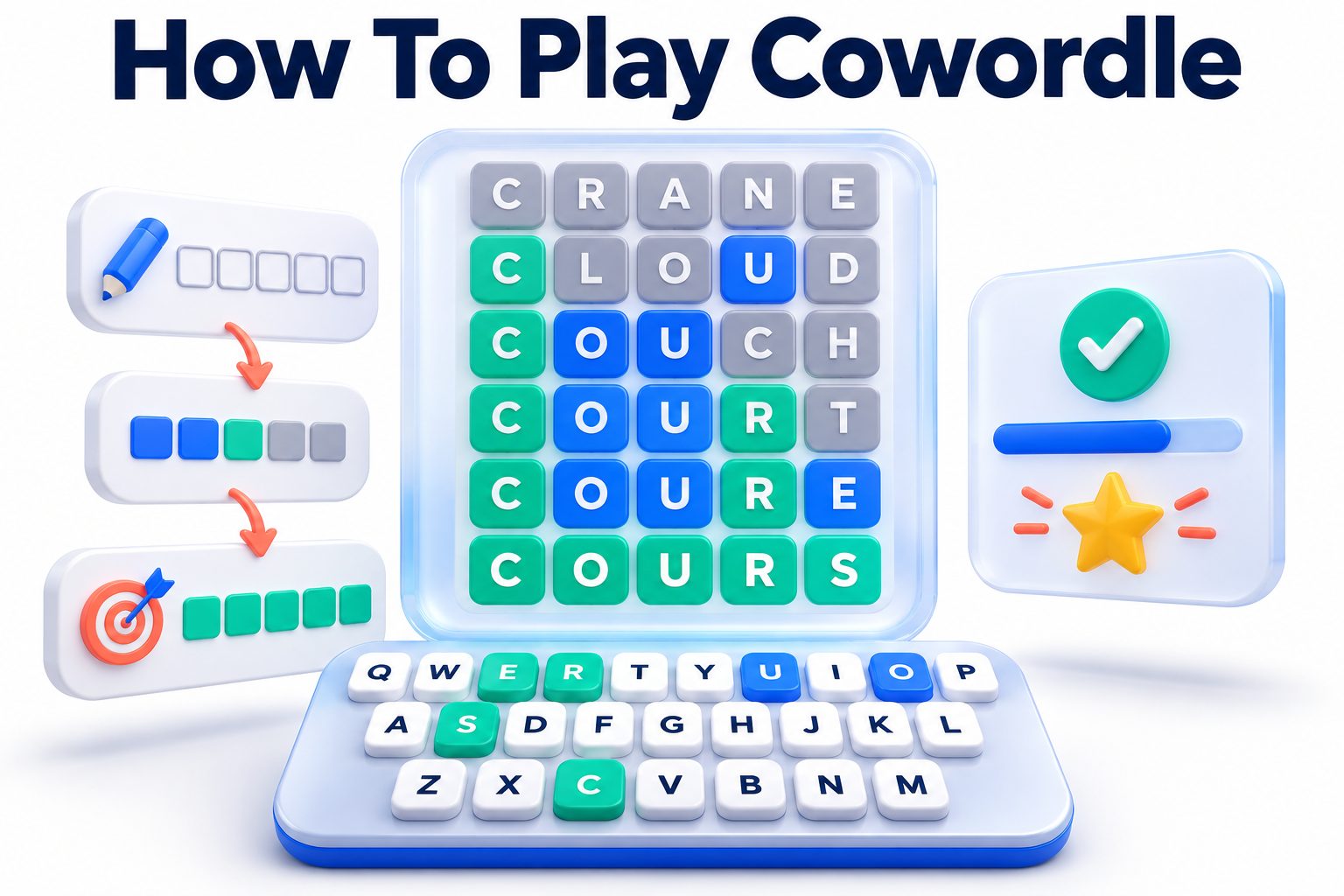
Once both players are in, the game presents a blank grid and an on-screen keyboard. Type a five-letter word, submit it, and use the color feedback to narrow the possibilities. In a race format, keep playing on your own board until someone finds the answer or the match ends.
1. Open a Cowordle game site and choose the option to create, host, or start a match.
2. Copy the room link or use the available share button to send it to your friend.
3. Wait until both players have joined and confirm the selected game mode.
4. Enter a valid five-letter opening word and submit it.
5. Read the tile colors carefully before choosing the next guess.
6. Continue until you solve the word, run out of attempts, or the game declares a winner.
Reading the Cowordle Tile Colors
The tile colors are the foundation of the game. A green tile means the letter is in the answer and already placed correctly. Keep that letter in the same position unless a repeated-letter clue gives you a reason to reconsider.
A yellow tile means the letter appears somewhere in the answer, but not in the position where you guessed it. A gray tile usually means the letter does not appear in the answer at all. Treat gray letters as exclusions, not as letters to keep recycling into future guesses.
Repeated letters require extra care. If you guess a word with two of the same letter, the game may mark one tile yellow or green and the other gray if the answer contains only one copy. Do not assume that every matching letter in your guess exists twice in the solution.
Using the On-Screen Keyboard Effectively
The keyboard gives you a quick record of which letters have been tested. Green and yellow keys represent useful letters, while gray keys usually identify letters you can avoid. It is a convenient reference, especially when playing quickly on a phone.
Still, the keyboard does not replace checking each row. A yellow letter has a positional restriction, and the keyboard alone cannot show where it failed. Before submitting another word, review the whole grid so you do not accidentally put a confirmed yellow letter back in the same location.
A Strong First-Guess Approach
Your first guess should test common letters in useful positions. Many players favor words with several different letters and at least two vowels, because they reveal more information than a guess full of duplicates. Words such as “stare,” “crane,” “slate,” and “adieu” are popular examples, though no single opener guarantees success.
A good opening word is not necessarily the word most likely to be the answer. Its purpose is to expose useful letter patterns. If your first guess reveals only one yellow letter, your second word should usually test several fresh, common consonants and vowels while moving that yellow letter to a new position.
When to Play for Information Instead of the Answer
After one or two guesses, you may know enough letters to see several possible answers. For example, if you have _ A _ E _ with a confirmed R somewhere, options may still include several common words. Guessing one candidate at random can be risky in a race.
Sometimes it is smarter to play a “probe” word that tests several possible letters at once. This costs a guess, but it can prevent you from wasting multiple turns on a pattern with many valid answers. In Cowordle, that trade-off matters because an opponent may solve while you are guessing between similar words.
Useful habits for early guesses include:
- Favor words with five different letters when you have little information.
- Test common vowels early, but do not use every turn solely to hunt vowels.
- Move yellow letters to new positions instead of repeating a known bad placement.
- Use green letters as anchors for likely word shapes.
- Avoid gray letters unless you have a deliberate reason to test a repeated-letter pattern.
- Keep an eye on your opponent’s visible progress when the game shows it.
Turning Clues Into Better Second and Third Guesses
The second guess is often where a Cowordle round becomes manageable. Use the feedback from your opener to choose a word that either rearranges confirmed letters or tests a new group of high-value letters. Do not simply pick another familiar word because it feels likely.
Imagine that “stare” gives you a yellow A and yellow R, while S, T, and E are gray. A productive follow-up could move A and R into different positions while testing letters such as L, I, N, or O. The goal is to reduce uncertainty, not to force an answer before the pattern supports it.
Speed Matters, but Accuracy Matters More
Fast typing helps in a race, particularly once the answer is obvious. Yet rushed guesses often repeat excluded letters, ignore a yellow-position rule, or submit a word that the game does not accept. A two-second pause to scan the grid can save an entire turn.
This balance is especially important when you can see an opponent nearing the bottom of their grid. Their progress may tempt you to submit the first plausible word. Instead, use the pressure as a prompt to verify your clues and make a strong decision.
Cowordle Strategy During Competitive Matches
Competitive Cowordle rewards a slightly different mindset from a solo puzzle. You are not only reducing the number of possible words; you are deciding how much information each guess gives you relative to the time and attempts remaining. A near-answer guess may be right, but a broad test word can be stronger when several options remain.
Pay attention to the match interface without becoming distracted by it. If the game displays your opponent’s solved rows or tile colors, it can show whether they are likely ahead. Use that information to decide whether to play safely for certainty or aggressively for a direct solution.
Adapting When You Are Ahead
When you have several confirmed letters and your opponent appears behind, prioritize certainty. Use the remaining attempts carefully, check for alternate words, and avoid unnecessary gambles. Being ahead only helps if you convert the clues into the right final answer.
A cautious player may use one information-rich guess to separate two or three likely answers. This is particularly valuable in patterns where several common words differ by only one first letter, such as _IGHT or _OUND.
Adapting When You Are Behind
When the opponent looks close to solving, you may need to take a calculated risk. If the pattern strongly suggests one common answer, entering it immediately may be wiser than spending a turn testing letters. A race is not always won by the most methodical player.
That does not mean ignoring the board. Risk should be based on evidence: fixed green letters, yellow letters that fit naturally, excluded letters, and common word patterns. Guessing random possibilities under pressure rarely produces a comeback.
Common strategic choices compared:
| Situation | Best General Move | Why It Helps |
|—|—|—|
| Few clues after the first guess | Test new common letters | It narrows the word pool quickly |
| Several possible answers share one pattern | Use a probe word | It identifies the distinguishing letter |
| One obvious answer fits all clues | Submit the answer | Extra testing only gives away time |
| Opponent appears ahead | Make an evidence-based direct guess | A careful gamble may be necessary |
| Opponent appears behind | Verify competing options | It reduces an avoidable final mistake |
Common Cowordle Mistakes to Avoid
The most common mistake is treating every turn as an attempt to solve immediately. Early in the game, a valid guess that tests several useful letters can be more valuable than a word that only rearranges information you already have. Think of each row as a source of evidence.
Another frequent error is forgetting that yellow tiles are position clues, not merely confirmation that a letter exists. If a letter is yellow in the third slot, it cannot be in the third slot of your next guess. This sounds obvious, but it is easy to overlook during a fast match.
Avoid these habits during a round:
- Reusing gray letters without a clear repeated-letter reason.
- Assuming a yellow letter must appear only once.
- Guessing words that violate a known green or yellow placement.
- Focusing so much on the opponent that you stop reading your own grid.
- Using obscure words simply because they contain many letters.
- Sending multiple room links and accidentally joining different matches.
Handling Invalid Word Messages
Cowordle versions usually accept only words in their own dictionary. A real word may still be rejected if it is uncommon, regional, pluralized in an unexpected way, or absent from that game’s accepted list. The rejection does not necessarily mean you spelled it incorrectly.
When this happens, do not waste time trying the same word again. Choose a more standard alternative that fits the same clues, or use a fresh test word. If a site repeatedly rejects ordinary entries, refresh the page and make sure the game is fully loaded before starting a new match.
Different Cowordle Modes and Site Variations
Cowordle is not controlled by one universal rule set. Different websites use the name for similar two-player word games, so details such as turn order, time limits, clue visibility, and win conditions can vary. The familiar five-letter color system remains the common thread.
The most widely recognizable format is a head-to-head race: both players solve the same answer independently, usually with six guesses. Other versions let players alternate turns, share a board, or collaborate on a single puzzle. Read the mode description before you assume the usual race rules apply.
Head-to-Head Races
In a head-to-head match, each player has their own grid and works toward the same hidden answer. The winner is normally the first person to solve it. If neither player succeeds within the available guesses, the game may end in a draw.
This format rewards speed and independent reasoning. Avoid relying on your opponent’s visible activity too heavily; their colored tiles may not reveal their exact guess, and watching them can interrupt your own pattern recognition.
Turn-Based and Shared-Board Games
Turn-based Cowordle gives each player a turn to submit a guess. Depending on the site, both players may see the same feedback and build on the shared board. The game becomes more tactical because one player’s guess shapes the next player’s options.
Shared-board versions are better for a relaxed game with a friend. Discussing possibilities can be part of the fun, but agree on communication rules first. If one person searches for answers online while the other does not, the puzzle quickly loses its purpose.
For more ideas on choosing word games for groups, see [Internal Link: multiplayer word games for friends]. If you prefer the solo format and want to sharpen your clue-reading skills first, [Internal Link: Wordle strategy tips] is a useful related resource.
Practical Tips for Playing With Friends
Choose a format that matches the mood. A timed race is fun when both players enjoy quick competition, while a shared puzzle works better when one person is new to Wordle-style clues. A short pre-game agreement avoids frustration over different expectations.
It also helps to play more than one round. One puzzle can be decided by an unusually difficult word or an unlucky opening guess. A small set of rounds gives both players room to adapt and makes the result feel less dependent on one tricky answer.
A simple match routine can keep games fair:
1. Confirm whether you are racing, taking turns, or cooperating.
2. Agree not to use answer solvers, word lists, or outside help unless both players want that format.
3. Start with a consistent number of rounds, such as three or five.
4. Keep the same guess limit and time setting for every round.
5. Take a brief pause between games so both players can reset and compare strategies.
Troubleshooting Common Match Problems
If your friend cannot join, first confirm that you sent the entire invite link. Messaging apps sometimes shorten, alter, or split URLs. Copying the link again from the game page and sending it as plain text often resolves the issue.
When a match does not start, both players should check that they selected the same room and have a stable connection. Refreshing can help, but do it cautiously: some game sites create a new session after a refresh. If the room disappears, have one player create a fresh private match.
Lag can also affect a close race. If one player’s tile updates are delayed, the final result may appear confusing. In casual games, the simplest solution is to start another round on a stronger connection. For more serious competition, use a game mode with clear timers and reliable room status.
Building Skill Beyond One Cowordle Match
Regular play improves your ability to recognize common letter combinations, vowel patterns, and likely word endings. You do not need to memorize a huge word list. What matters more is learning to separate likely answers from words that merely fit a few letters.
After a match, review the turning point. Did an opening word reveal too little? Did you overlook a yellow position? Did you guess a likely answer when an information word would have settled the pattern? That brief reflection makes the next round more useful than simply playing again on autopilot.
Conclusion
Cowordle keeps the familiar satisfaction of a five-letter word puzzle while adding a social, competitive edge. Start by confirming the game mode, joining the same room as your friend, and using the green, yellow, and gray tiles as precise clues rather than loose hints. Strong opening words, careful placement of yellow letters, and a willingness to use information-rich guesses will usually matter more than typing at top speed.
The best approach changes with the board. Test broad letter combinations when you have few clues, use a probe word when several answers fit the same pattern, and make a direct attempt when the evidence clearly points to one answer. Watch your opponent only enough to judge the pace of the match; your own grid should remain the priority.
Once you know how to play cowordle, the game is easy to pick up and rewarding to improve at. A few thoughtful rounds with a friend can sharpen your word-solving habits while keeping the competition light and entertaining.
Frequently Asked Questions
Is Cowordle the same as Wordle?
No. Cowordle uses similar five-letter guesses and colored tile feedback, but it adds multiplayer play. Most versions let two people race to solve the same word, while some offer turn-based or cooperative modes.
How many guesses do players get?
Many Cowordle race versions give each player six guesses, matching standard Wordle. Rules can differ by website or mode, so check the game screen before starting, especially when playing a timed or shared-board match.
Can I play Cowordle with a friend remotely?
Yes. Create a private game room, copy the invite link, and send it to your friend through a message or email. Once both players join, the game typically starts with the same hidden word.
What do yellow tiles mean in Cowordle?
A yellow tile means the letter appears in the secret word but is in the wrong position. Move it to a different slot in later guesses while keeping all green letters fixed in their confirmed positions.
Is Cowordle free to play?
Most browser-based Cowordle versions are free to access. Features such as matchmaking, private rooms, ads, time limits, and account options vary by site, so review the selected game’s rules before inviting another player.